Imagine someone lands on your website looking for exactly what you offer. A user who searched "bathroom renovation Alicante" and clicked on your ad or Google result. They arrive on your site and are greeted by the navigation menu, an about us section, the blog, a project gallery, a list of all your services... and after 30 seconds they leave without making contact.
This is not a design problem. It's an architecture problem. And the solution has a name: a landing page.
The difference between a corporate website used as a catch-all destination and a well-designed landing page can easily be the difference between a 2% conversion rate and an 8% conversion rate. For a business receiving 500 visitors a month, that's the difference between 10 and 40 potential leads — every single month. The numbers matter.
What exactly is a landing page
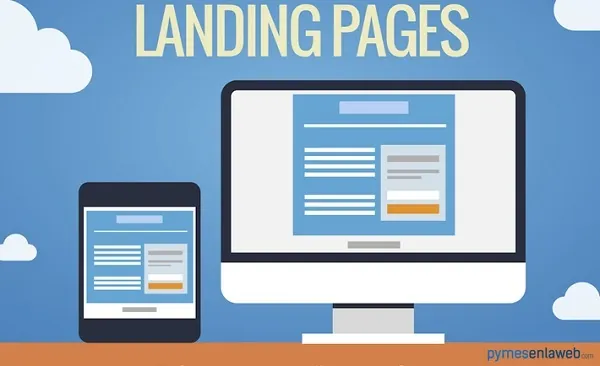
A landing page is a web page designed with a single objective: to get the visitor to take one specific action. That action might be calling you, filling in a form, subscribing to a newsletter, downloading a document or completing a purchase.
What distinguishes a landing page from any other page on your website is its absolute focus. There is no navigation menu inviting the user to explore other sections. There are no secondary links leading to other pages. There are no sections that don't directly contribute to the visitor taking the desired action.
Every element on a landing page — the headline, the body copy, the images, the testimonials, the call-to-action button — exists for a single reason: to convince the visitor that taking this particular step right now is the best decision they can make.
This isn't manipulation. It's clarity. Users who arrive with a clear intent appreciate it. Someone searching for "kitchen renovation quote Alicante" doesn't want to read your company history. They want to know whether you can solve their problem, what results you've achieved for others and how to get in touch. A well-designed landing page gives them exactly that, nothing more and nothing less.
Landing page vs. corporate website: when to use each
Many businesses have a corporate website and assume that's sufficient. For some situations, it is. For others, you need something more specific.
A corporate website is the complete presentation of your business. It includes who you are, all the services you offer, case studies, a blog, contact information. It's the digital equivalent of your headquarters — the place where anyone can come and get to know you thoroughly. It's ideal for people who search for your name directly, for building long-term brand credibility and for ranking in Google with varied content.
A landing page is a specific conversion instrument. It doesn't try to present everything you do. It resolves a single doubt and guides the user towards a single step. It's ideal when:
- —You're running paid advertising on Google Ads, Meta Ads or other platforms, and you need a destination page that maximises return on investment.
- —You want to rank a specific service or product in Google for a high-intent keyword.
- —You're launching a promotion, an event or a time-limited offer.
- —You want to generate leads efficiently for a high-value service.
The question isn't "do I need a corporate website or a landing page?" — it's "what do I need for this specific goal right now?" Most businesses benefit from having both: a corporate website as the foundation and specific landing pages for key campaigns or services.
A practical example: a dental clinic in Valencia might have its full corporate website and also a dedicated landing page for "dental implants Valencia" that captures users searching specifically for that treatment, with patient testimonials, before-and-after photos, a transparent price range and a free consultation booking form.
The 7 parts of a landing page that converts
An effective landing page isn't designed by intuition or aesthetics alone. It has a proven structure that responds to how users actually make decisions. These are the seven parts every converting landing page must have:
1. Headline with a value proposition
This is the first thing the user sees. You have fewer than 5 seconds for them to understand what you offer and why it's relevant to them. A strong headline doesn't describe what you do — it describes the result the customer gets. "Your kitchen renovation completed in 30 days, with a guaranteed fixed price" is more effective than "Renovation company in Alicante".
2. Supporting subheadline
A short sentence below the headline that expands on the value proposition or addresses the most common objection. It complements the headline without repeating it. For example: "Over 200 renovations completed in Alicante and Valencia. Free quote within 24 hours."
3. Hero image or video
The main visual at the top of the page, visible before any scrolling. It must be relevant and high-quality. For a service business, the ideal is to show the finished result or the team at work. For a product, the product in use. A generic stock image in this position damages credibility rather than building it.
4. Benefits, not features
This distinction is fundamental. Features describe what your service is or does. Benefits describe what the customer gains. "We use premium materials" is a feature. "Your renovation will look brand new for at least 15 years" is a benefit.
The benefits section is typically presented as a list with icons or as short blocks of explanation. Aim for no more than 5–6 points. More than that overwhelms the reader.
5. Social proof
Humans make decisions based on what others do and say. Social proof on a landing page can take several forms:
- —Reviews and testimonials from real customers, ideally with name, photo and description of their project.
- —Logos of well-known clients (if you've worked with recognisable companies or brands).
- —Numbers: "over 200 projects completed", "94% of clients satisfied", "in business since 2015".
- —Case studies: before and after, with specific measurable outcomes.
Without social proof, visitors have no reason to believe what you promise is real. With compelling social proof, the friction to making contact drops dramatically.
6. Clear and repeated CTA
The call to action is the button or form the user needs to take the next step. It must be:
- —Clear: It must be perfectly obvious what happens when you click it. "Request your free quote", "Call now", "Book your consultation" all work. "Submit" or "Click here" don't.
- —Repeated: On a longer landing page, the CTA should appear at least two or three times — once near the top (for users who are already convinced), once in the middle and once at the bottom.
- —Visible: High contrast so it stands out clearly from the surrounding content.
Excessively long forms (more than 5 fields) reduce conversions. Ask only for what's essential: name, phone number or email, and perhaps one specific question about the service.
7. FAQ section to eliminate objections
Every user who arrives on your landing page has questions and doubts. If those aren't resolved, they prevent the user from taking action. A frequently asked questions section at the bottom of the page resolves the most common objections before the user has to make the effort of contacting you to ask.
"How long does the process take?", "Is there any commitment in requesting a quote?", "Do you work outside of Alicante?", "What guarantees do you offer?" — anticipate these doubts and resolve them directly.
Types of landing pages by objective
Not all landing pages have the same purpose. Depending on what you want to achieve, the design and content vary accordingly:
| Type | Objective | Primary action |
|---|---|---|
| Lead generation | Capture contact details | Form, phone call, WhatsApp |
| Direct sales | Sell a product or service | Buy button, checkout |
| Launch / pre-sale | Build interest before launch | Registration, waitlist |
| Event or webinar | Collect registrations | Registration form |
| Content download | Deliver a resource in exchange for email | Download form |
| Click-through | Warm up the user before a sales page | Button to sales page |
For most local businesses in Alicante and Valencia, the most relevant types are lead generation (getting potential customers to leave their contact details so you can follow up) and direct sales for products or services with a fixed, transparent price.
Examples of local businesses that use landing pages successfully
These are the types of businesses for which landing pages have the clearest, most measurable impact:
Clinics and aesthetic centres: A specific landing page for "teeth whitening Alicante" or "laser pigmentation removal Valencia" captures a user with very high purchase intent. Include pricing, before-and-after photos, patient testimonials and a free consultation booking.
Law firms and solicitors: Legal searches tend to be highly specific ("divorce lawyer Alicante", "insurance claim Alicante"). A landing page per practice area — explaining the process, resolved cases (anonymised) and a free initial consultation — converts far better than a generic law firm website.
Academies and training centres: For course enrolments. A clear deadline, limited places, testimonials from previous students and a registration form. Urgency combined with proof is a powerful combination.
Home service companies: Renovations, plumbing, electrical work. Landing pages with a clearly defined service area, response times, guarantees and a quote request form.
Agencies and consultancies: To capture free diagnostic meetings. A clear value proposition, success cases with real metrics and a direct calendar booking link.
How much does a professional landing page cost?
Price ranges vary depending on complexity and who builds it:
- —Template-based landing page (Webflow, WordPress, etc.): €400 – €1,200
- —Bespoke landing page with custom design: €1,200 – €3,500
- —High-performance landing page with A/B testing and conversion optimisation: €3,000 – €8,000+
The right budget depends on the value of the customer you're trying to capture. If each new customer is worth €5,000 to your business, investing €2,000 in a landing page that brings in 3 new customers a month is one of the best returns available. The maths works if you know your numbers.
What does Corexia charge for a landing page?
The prices above reflect what the general market charges in Spain. At Corexia, we work at roughly a third of those prices — because we're software engineers working directly with you, with no agency layers or account managers in between.
| Landing page type | Market price | Corexia price |
|---|---|---|
| Conversion landing page (custom design) | €1,000 – €3,000 | from €350 – €900 |
| Landing page with CRM or advanced analytics integration | €2,000 – €5,000 | from €700 – €1,500 |
The technology doesn't change: Next.js, TypeScript, maximum speed and technical SEO from day one. What changes is that you don't pay for Madrid city-centre rent or a sales team. If you're comparing quotes, reach out and we'll walk you through exactly what each euro goes towards.
Metrics to know whether your landing page is working
A landing page without metrics is a black box. These are the metrics to monitor:
Conversion rate: The percentage of visitors who complete the desired action. A landing page for local services with good traffic segmentation should sit between 5% and 15%. Below 3%, something needs improving — likely the headline, the offer or the source of traffic.
Bounce rate: The percentage of users who arrive and leave without interacting. Above 70%, the problem is usually the headline or poorly targeted traffic.
Time on page: A well-designed landing page holds the user long enough to read the proposition and make a decision. An average below 30 seconds usually means the content isn't connecting.
Scroll depth: How far down users actually scroll. If 80% leave before seeing the testimonials section, that section isn't doing its job — or it needs to move higher up the page.
Traffic source: Knowing whether converting users come from Google Ads, organic SEO or social media lets you optimise investment in each channel.
Conclusion
A landing page is not a luxury reserved for large companies. It's a practical tool any local business can use to convert more visitors into customers — especially when combined with paid advertising or SEO targeting high-intent keywords.
The difference between a page from your corporate website used as a campaign destination and a landing page designed specifically for that objective can realistically be 3x in conversion rate. That means three times as many leads from the same amount of traffic.
If you have a service you want to sell more effectively, or a Google Ads campaign that's not delivering the results you expected, the problem is very likely the destination page.
At Corexia, we design conversion-focused landing pages for businesses in Alicante, Valencia and across Spain. If you'd like us to review what you currently have, or help you design one from scratch, get in touch for a free consultation.
Do you want your business to appear on Google?
We discuss your business, your competition, and what you really need. No obligation. We'll respond in less than 48 hours with clear guidance and a fixed quote.
Schedule Free Consultation